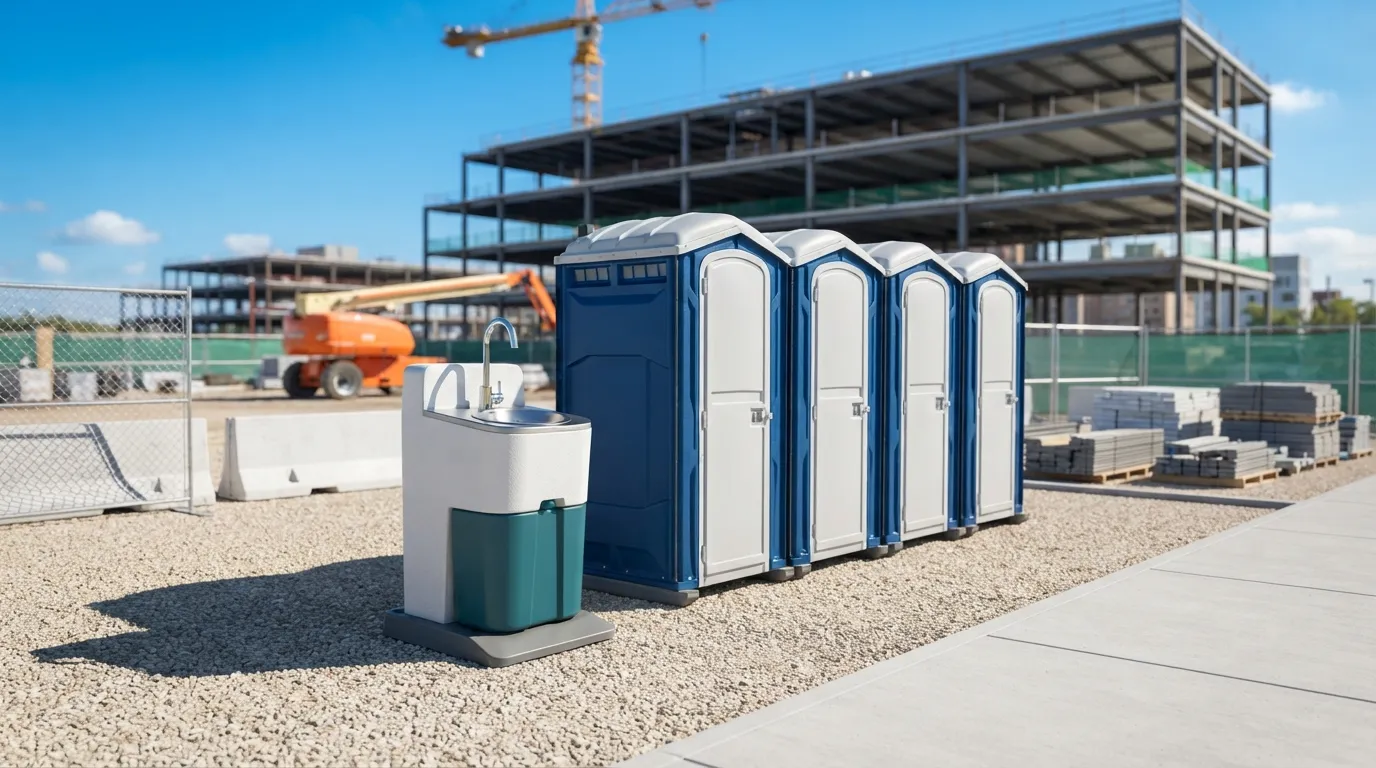
Handwashing stations are required on most Germantown construction sites, and OSHA backs it with two separate rules. Under 29 CFR 1910.141(d)(2), workers need soap and towels or a hand dryer, not just sanitizer. Germantown Porta Pros sets up stations from 15 dollars a day inside the fence rate.
There's no flat unit count tied to worker headcount the way toilets work, but the practical rule crews use is one station near every toilet bank. If you're running standard porta potty rental units at 100 to 350 dollars a day, pair each cluster with a sink so nobody's walking site to site with dirty hands. Sites doing painting, coating, herbicide or pesticide work fall under OSHA 1926.51(f)(1), which specifically requires washing facilities for those contaminant tasks, separate from general sanitation. Farms around Germantown fall under a different rule: OSHA 1928.110 requires field sanitation with a handwashing facility within a quarter mile walk, one per 20 hand-labor employees. If you're staffing a produce operation near Clarksburg, 5.0 miles north of Germantown, that quarter mile figure matters more than any generic toilet count. Check farm and agricultural restrooms for what pairs with it. Most general contractors just order a handwashing station rental alongside their toilets and skip the math.
29 CFR 1910.141(d)(2) is the core rule: soap, and towels or a hand-drying device, at every wash station. Sanitizer alone doesn't satisfy it, no matter how much you squirt on. That's a common mix-up we clear up for first-time renters. General sanitation and toilet counts run under OSHA 1926.51(c), which sets one toilet for 20 workers or fewer on a construction site, scaling up from there. Neither of those rules covers handwashing directly, which is why 1910.141(d)a(2) does the heavy lifting once you're outside the paint-and-pesticide carve-out in 1926.51(f)(1). Potable water ties in too. OSHA 1926.51(a)(1) requires an adequate supply of potable water at every place of employment, and a handwashing unit without a filled tank doesn't count as compliant, just as decoration. We fill and service every unit on a route that also covers our porta john rental stops, so nothing runs dry mid-week. If your crew is also using portable sink rental units for food prep, the soap-and-towel standard applies there too, not just at the job trailer.
No. Hand sanitizer stations don't satisfy 29 CFR 1910.141(d)(2) on their own, because the rule specifically calls for soap and towels or a drying device. Sanitizer works as a supplement, not a replacement. A lot of Germantown job sites keep both: a proper sink for the OSHA box and a hand sanitizer station rental at the gate for anyone walking through fast. Event sites lean the other way. A wedding at a Germantown venue or a race staging area doesn't answer to construction sanitation rules the same way, so sanitizer stands do more of the daily work there, paired with event restroom rental units. If you're planning a marathon and race restrooms layout, sanitizer at every mile marker makes more sense than a full sink, but the start and finish areas should still carry real handwashing setups. We build both into quotes depending on what the site actually needs, not a one-size template.
Right next to the toilets, and close enough that nobody skips the walk. That's the short answer, and it holds for construction, farms and events alike. ADA Standards section 403.5.1 sets a 36 inch minimum clear width for the accessible route leading to any unit, and that applies to the path to your handwash station too if it's part of a compliant cluster. ADA Standards section 213.2 requires that where portable toilets are grouped, at least 5 percent must be accessible, never fewer than one, and the accessible sink should sit in that same accessible run. See ADA accessible porta potty for the unit specs. Ground surface matters as much as width. ADA Standards section 302.1 calls for stable, firm, slip-resistant footing, which rules out setting a sink on loose gravel or soft turf without a pad underneath. For multi-week jobs, our porta potty placement guide covers where to stage units so delivery trucks can still get in. A roll-off delivery alone needs about 60 feet of straight clearance behind the truck, so layout planning matters before anything gets dropped. Sites running a temporary fence rental perimeter should keep handwash stations inside the fence line, not out by the road.
| item | day | week | month |
|---|---|---|---|
| standard toilet | 100-350 | 130-500 | 125-325 |
| ADA unit | 200-400 | 120-240 | not sold monthly here |
| fence per panel | 30-75 | not sold weekly here | not sold monthly here |
Placement in the public right of way needs confirming with the city before you set anything at curbside. Most job-site and yard placements don't need one, but check with Germantown before staging near a sidewalk or road. See porta potty permit requirements for what else might apply.
Yes. Plenty of Germantown kitchens, food trucks and small crews rent a standalone portable sink rental unit without toilets attached. It works fine for short jobs, but OSHA still expects toilets nearby once you've got a full crew on site under 1926.51(c).
Weekly is standard under the ANSI/PSAI Z4.3 baseline for up to 10 users over a 40 hour week. Busier sites need more frequent stops. Ask about a route add-on when you book your porta potty rental cost quote.
A handwashing station has running water, soap and towels, meeting 29 CFR 1910.141(d)(2). A sanitizer stand is gel or foam only, no water. They serve different rules and different situations, and most active job sites need the real sink, not just the stand.
No, they're separate services. Septic work covers tanks and holding systems; see septic pumping service. Your handwash unit gets serviced on its own route regardless of any septic visit scheduled that week.
Yes. Germantown Porta Pros delivers handwashing station requirements across Germantown and the surrounding metro, with same-day and next-day drop-off available on most orders.
Pricing depends on the unit and how long you need it. See our cost breakdown and request a free quote for an exact figure.
Standard rentals include scheduled service — a pump-out, a clean, a restock and fresh deodorizer. Busy or hot-weather sites can be serviced more often.
Call now or request a free quote — clean units, on-time delivery, transparent pricing.