A county fair pulling a few hundred people a day needs restrooms figured by attendance, not guesswork: standard units run 200 to 800 dollars for the event under our measured pricing, and ADA units add roughly 120 to 240 dollars a week. Germantown fair organizers should plan restroom counts before gate day, not after.
Start with headcount, not habit. OSHA 1926.51(c) sets construction-site ratios at 1 toilet for 20 workers or fewer, scaling up as crews grow, and while that standard covers job sites rather than fairs, it is the closest guidance most Germantown organizers use as a baseline when nothing else applies. For a multi-day fair with several thousand visitors passing through, most planners lean toward standard units in blocks, then add ADA accessible units at a ratio drawn from ADA Standards section 213.2, which requires at least 5 percent of clustered single-user units to be accessible, with a minimum of one no matter how small the cluster. A fair with ten standard units on site needs at least one accessible unit under that rule.
Our how many porta potties do I need guide walks through headcount math in more detail, but the short version for Germantown fairgrounds is: count peak-hour attendance, not total daily turnout, because that is when lines form. Pair standard units with a handwashing station rental near food vendors, since 29 CFR 1910.141(d)(2) requires soap and a towel or hand-drying device at wash stations, not sanitizer alone. If the fair runs a beer garden or funnel cake fryer, hand sanitizer stations near those booths cover casual contact, but the food line still needs a real wash station under that same rule.
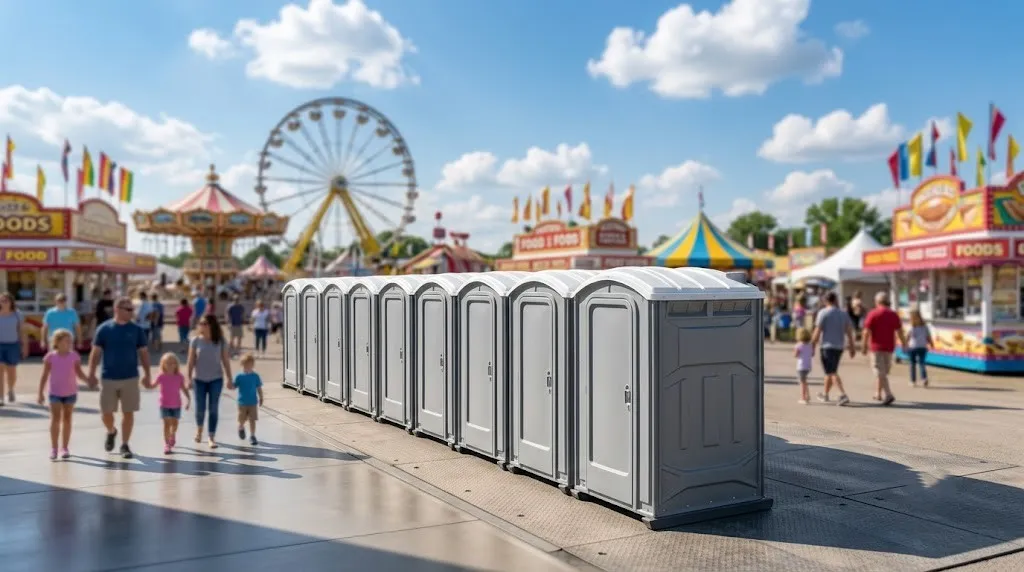
Multi-day events wear standard units hard, so servicing schedule matters as much as unit count. A standard porta potty holds 60 to 70 gallons and services well under the ANSI/PSAI Z4.3 baseline of one visit per week for light use, but a fair packs a week of use into a weekend, so Germantown Porta Pros schedules extra pump-outs for anything running Friday through Sunday.
For fairs expecting a bigger crowd or wanting a nicer option near a beer garden or VIP tent, a deluxe flushable unit runs 85 to 1200 dollars a day depending on features, or 150 to 290 dollars for a full week if the fair spans that long. Bigger fairs with grandstands or midways sometimes bring in a restroom trailer instead, and a 4 stall restroom trailer or 8 stall restroom trailer handles higher traffic near the main stage without the line buildup single units create. Ground surfaces for any unit need to stay stable and firm per ADA Standards section 302.1, which matters on fairground grass that gets soft after rain.
Delivery for a fairground layout typically runs 100 to 500 dollars depending on distance and site access, and a roll-off dumpster or two near vendor row keeps trash off the walking paths. Germantown fairs pulling crowds from Montgomery Village, 4.8 miles east, or Clarksburg, 5.0 miles north, often need extra units simply because attendance runs higher than a single-town event.
Placement in a public right of way, or on land not directly controlled by the fair organizer, needs confirming with the City of Germantown before delivery. We have not verified a specific ordinance number for fairground sanitation placement, so check with the city's permitting office directly rather than assume a blanket exemption. Our porta potty permit requirements page walks through the general process, and our dumpster permit requirements page covers the roll-off side if the fair needs debris containers on a street or lot with restricted access. Fairgrounds set back from public roads on private acreage usually face fewer hurdles, but confirming early beats a scramble two days before gates open.
Book as soon as dates are set, ideally 60 to 90 days out. Fair season stacks demand across Germantown and nearby towns like Rockville, 9.8 miles southeast, so units get reserved early. Use our request a quote page to lock dates.
Yes. ADA Standards section 213.2 requires at least one accessible unit per cluster, minimum 5 percent of the group. Accessible units run 120 to 240 dollars a week in our measured pricing, less than a single day at the high end.
Standard units run 200 to 800 dollars for an event booking. Deluxe flushable units start similarly but can run higher with added features. See our porta potty rental cost page for a fuller breakdown by duration.
Yes, especially near food vendors. 29 CFR 1910.141(d)(2) requires soap and towels or a drying device, which sanitizer stations do not satisfy. Pair both types near cooking booths.
Often, yes. An 8 stall restroom trailer moves more people through faster than a bank of single units, which matters most near a main stage or grandstand where lines build fast during breaks.
Call now or request a free quote — clean units, on-time delivery, transparent pricing.